For most of my life, I believed I wasn’t a runner. I can pinpoint the exact moment this conviction took root: primary school race day. It was a hot summer afternoon in Pretoria, and the sun was beating down on the unknown track. Because I attended such a small school, I made the athletics team by simply adding my name to the sign-up sheet. Looking back at it now, I realise that even then, I possessed some primal knowing, some need to run. Throughout my life, I was fascinated by anything that pushed the human body physically – long-distance running, mountaineering, even the military and the supreme feats of endurance and scarcity borne by monks. But, that fateful race day, along with subsequent events that cemented my “identity” as non-athletic, exiled me to a decade of resignation.
Remembering it now, I envision a packed stadium encircling the athletics track with about fifty eight-year-old runners ready to throw it down for the ultra-race of their lives. In reality, it was probably a meagre gathering of parents coming together to watch the ten or so kids race the 800 meters on a hot Wednesday afternoon at a small-town school’s weather-beaten grass track. Be that as it may, I prefer the richly coloured hues of memory. So, we are lined up and ready to take off. Besides a few scatterings of netball games, I have never done much running before that moment. My parents were highly athletic in their day (or so I’m told), but alas, by the time I was born, all of that receded into the history books. Consequently, I heard many stories of their athletic pursuits but was never dragged along for a run in my young life. However, unbeknownst to the rest of my competitors, I had an iron-clad race strategy that would leave them all in the dust. In the car, on the way to the race, my dad told me how he consistently won long-distance events in his younger days. When the starting shot rang out, he would full-out sprint until he could no longer, and then he would ease back into a recovery pace after gaining a significant lead. To my little mind, this sounded like a perfect plan. So, when the gunshot rang, I moved as fast as my legs could carry me. For the first few metres, I was in the lead. I couldn’t believe it! The plan was working so beautifully that I wondered why everyone wasn’t trying it. I quickly learned why, though. After a brief taste of front-of-the-pack running, I obviously became exhausted from my all-out sprinting and began to fall back. Those who started easily also easily overtook me. Because I wasn’t used to running, I didn’t know how to recover on the move, so I had to slow down to a walk. It wasn’t long before the entire group overlapped me. At one point in the race, I had my hands on my hips, walking slowly, while everyone else ran in a pack on the opposite side of the track. A small boy with a mouth full of half-masticated hot dogs stepped right in front of me.
“Get off the track!” he said, “They’re in the middle of a race.”
“I’m in the race!” I cried, sweat-drenched and chest on fire.
After everyone had already finished, I still had about an entire lap to go. I was so slow that the whole crowd, even the parents of my competitors, started cheering for me. At one point, they cheered my name over the intercom, hoping to get me across the finish line so they could move on to the next scheduled race.
Needless to say, I was pretty traumatised after that. My dad apologised profusely, saying he forgot just how fit he was when he employed the sprint-and-recover strategy. I knew it wasn’t his fault. In the car on the way home, I was already convinced that the little boy was right – I shouldn’t have been in the race. That day I promised I would never embarrass myself like that again.
A few years passed with me honouring that promise until, at fourteen, I got the itch again. Or should I say, I heard the primal call. During the long December holiday before my first year of high school, I decided to reinvent myself – I would finally become the greatest long-distance runner the nation had ever seen. I trained the entire month before school started. Granted, my training consisted of around nine minutes of light jogging every other day. By the time I rocked up to the grade eight athletics day, I had already told everyone that I’m a long-distance runner (got to love the self-confidence) and challenged one of my fit-looking classmates to a personal dual (without knowing that she was one of the top national sprinters in our age group). I was pumped and fuelled by the confidence of my meagre training. This time, at least, I finished the 2500-metre race in the middle of the pack, but not without basically fainting at the end. It was only after speaking to the girl I personally challenged that I realised I finished fifteenth in one of the sixteen different heats (my high school was much bigger than my primary school). She went on to win her heat and set a new school record. Alas, my running career hit another roadblock.
What followed was five years of high school where I proudly, and by default, took on the new identity of the nerdy writer, library inhabitant, fiery member of the debate team and mediocre C-team netball player. Wherever I went, people told me I just wasn’t athletic. I wasn’t a born runner. And I, on my part, did everything I could to prove them right. I stopped training, buried my interest in running, and strapped on a protective cloak of self-deprecating humour on the netball court. So, a few years later, when, out of the blue, my college roommate suggested we go for a run, I laughed. At that point, neither of us was a runner, and I had comfortably shifted into my self-definition of non-athleticism.
“I’m serious,” she said as we ambled beneath the jade-coloured oak trees of our university town.
I laughed some more, but she persisted. I agreed after a while, but only with the promise that we would eat big bowls of pasta afterwards.
As I put on my running shoes, I was surprised to feel excitement welling up in my chest. In fact, I had butterflies. During those first few strides, it honestly felt like I was in love. My chest fluttered, my heart pounded, and I couldn’t feel my cheeks. Sure, we couldn’t run more than 600 metres, but it was already too late. I had felt it – not the overarching need to win a race or prove myself, but just the faintest sense of something clicking into place. I came back the next day to try and explore that feeling. Of course, the sensation was so slight that were I left to my own devices, I probably never would have exerted the effort to try again. But luckily, my roommate was adamant. So, we set out to run three or four times a week for the next couple of months. By the time the December holidays rolled around, I was already hooked. I went back home, being able to run the entire three-kilometre route on our farm for the first time in my life.
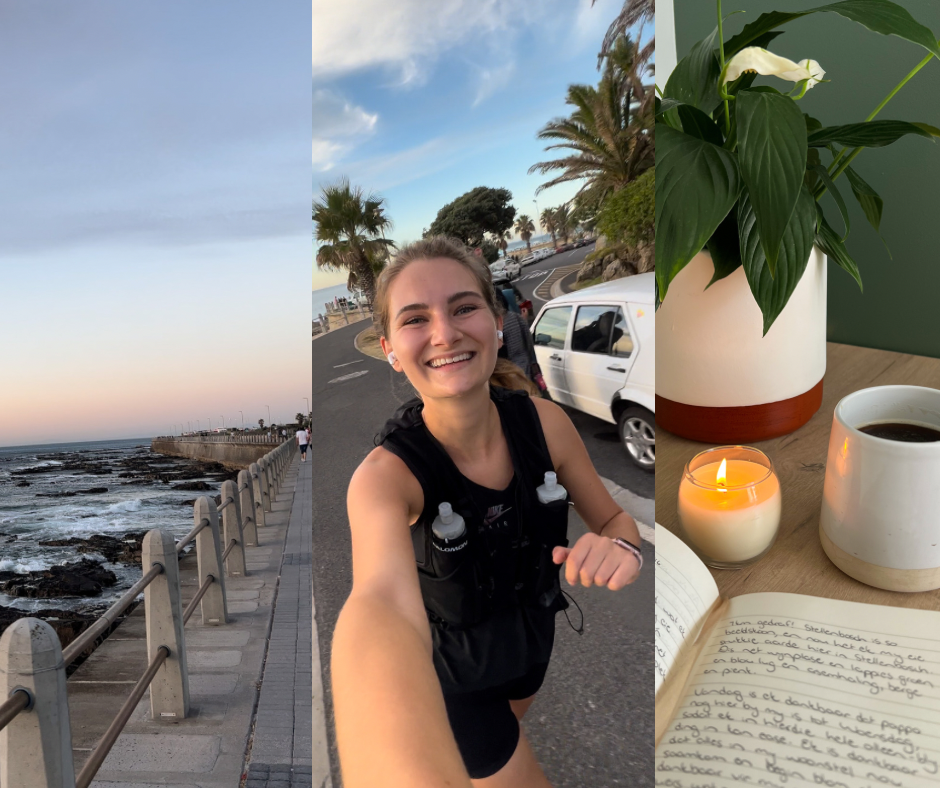
For me, running was like a gateway drug. By the time I was racking up 5 K’s, I was already deep into researching healthier living and strength training. Fast forward two years, and I am a certified health coach who just signed up for her first half marathon. I’ve come a long way from the eight-year-old girl with the whisper in her heart telling her to run. This past Saturday, I was doing a 10K easy run along the Sea Point promenade in Cape Town. As I watched the sunset over the Atlantic ocean, felt my steady heartbeat, and smiled at other runners, I realised I had rewritten myself. Running has improved every facet of my life. I am a happier, more content, grateful and more confident person than I was a few years ago. I feel more connected to my body and, consequently, more connected to myself. That, in turn, makes me a better writer. My ability to endure and even enjoy the effort needed for a run has increased my ability to endure personal and academic stress. I have also learned that being a nerd or a writer is definitely not opposed to being a runner. Now, some of my favourite books, alongside The Great Gatsby and Daisy Jones and The Six, are Born To Run and What I Talk About When I Talk About Running. You can satisfy your nerdiness in almost any field. When I started my training journey, I was surprised to find how many books are written about running – not just training manuals, but beautiful, poetic and narratively rich books about the art of running.
Herb Elliot, the Olympic champion and world-record holder in the mile who retired undefeated, said: “Poetry, music, forests, oceans, solitude – they are what develop enormous spiritual strength. I came to realise that spirit, as much or more than physical conditioning, had to be stored up before a race.” Jenn Shelton and Billy Barnett, the twenty-one-year-old couple from California that dominated the ultra-marathon racing world in the 2000s, trained to the sound of beat poetry. Haruki Murakami, one of the most celebrated writers of our time, runs a marathon every year and fuels his writing with his training, and vice versa. Creativity is bred outside of one’s comfort zone, in solitude, in nature, amid great strife, and on the threshold of the human and the divine. That, to me, sounds a lot like running.
I have learned that the self is permeable. It fluctuates and flows, often carrying narratives that others have thrown at you or that you have adopted as self-preservation. But underneath all of that lies some guiding whisper. When you quiet the noise around you, you’ll hear the primal call. I fell in love with running when I did it just for myself – no competitors, no noise, no race. Just pure movement and sky and breath. Out there, on the trails or on the road, I feel most connected to the inner cosmic part of myself that wants to be more. Why? Because running connects us to our humanity, the universe, our ancestors, and history. It reminds you that you’re alive but also that being alive isn’t even half of it. It’s what you do with the living part that’s all the fun.




Leave a Reply