(Read part I and part II here)
If you’ve been following along, you’ll know things have already started to unravel. Our captain is lying on the stern of the boat, shivering, mumbling to himself, his leg leaking pus. We’re in a remote region of Eastern Indonesia with no way to reach shore, and our international numbers can’t connect to local authorities.
I check Dan’s blood sugar and it’s 25. It’s supposed to be between 4 and 7, so I can only imagine what his body is going through. I make sure he gets some insulin in while Leon researches the best way to get medical help.
But the problem is, it’s Eid. Everything is closed. And neither Leon nor I know how to operate the tender yet, so we can’t get him to shore from where we’re anchored in the marina. Eventually, we found a national emergency number for Indonesia that we could WhatsApp. We exchange a few messages, then get redirected to Wakatobi’s emergency services, who send us the only number they have on file for the island of Tomia. Not an emergency number, but a number for the head of tourism. I briefly wonder what the head of tourism does on an island with no tourists, but then decide my faculties should be focused elsewhere.
After two hours of back-and-forth messaging, calling with Dan’s girlfriend back in Australia, and Google translating Indonesian text messages next to his half-conscious, pale-looking form, we have all the admin in place to either get our captain airlifted off the boat and flown to a hospital in Makassar, or get an ambulance boat to take him to a clinic on an island two hours away.
Just as the message comes through that the evacuation is ready to go ahead, he wakes, more lucid now. Shocked by the arrangements we’ve made, he insists there’s no way he can afford it. As it turns out, he doesn’t have any medical insurance.
The solo sailor with diabetes has no medical insurance.
Okay, well, cancel the chopper, park the ambulance boat, apologise to the lovely Tomia head of tourism, and, upon Dan’s instructions, go to bed.
We plan to head out to the local medical centre first thing in the morning, but until then, I wake once in the night to check on him. Now that his blood sugar is relatively under control, things might be looking better.
Upon arrival in the grey morning light, our first impressions of Tomia were one of desolation. If I were inclined to little fabrications, I would say that tumbleweeds were blowing through the empty streets. But I am not, since Leon reads everything I write about our adventures and fact-checks me relentlessly, like only a German can. So no, there were no tumbleweeds, but there was the odd child peeking from behind a closed curtain, little fingers and curious eyes flickering into and out of view.
Just beyond the small harbour, the first few streets were lined with houses in various states of decay. Despite this, all of them seemed to be occupied, each bearing some sign of human habitation – towels drying over railings, a toothbrush on a windowsill, a half-moon of plastic stools around which the air still faintly carried the sounds of laughter, conversation, traces of a party seemingly just departed.
The streets were perforated with shallow craters, like a slab of Swiss cheese left out in the heat, and the colours of the houses seemed dulled by years under the tropical sun. But the green was alive and blindingly bright. Between the houses, spilling over the streets, climbing up the walls, layered over the distant mountains, were veils of jungle – coconut palms, banana trees, frangipani – all dissolving into a dense, breathing blur.
As we ventured further away from the harbour, more signs of life began to reveal themselves: two old ladies smiling toothlessly at us from where they were washing dishes out of a bucket in the garden, a young man getting a haircut from another on a stoop, little girls in burkas chasing each other across the street, all looking at us first with shock, then wide, elated smiles. More scooters appeared. We also passed three mosques over what was probably 600 metres. It seemed we were nearing the heart of the village, and although it would be an exaggeration to call it “buzzing,” it was definitely more lively than we first imagined.
After about thirty minutes and some directions from the locals, we finally made it to the Tomia Community Medical Centre. Luckily, about halfway through, a nice man on a scooter spotted Dan’s leg and offered him a ride. Up until that point, he was hobbling along, leaving a trail of grunts behind him, stubbornly refusing a hand from me or Leon.
The clinic was not much more than three rickety beds and peeling wallpaper. When we got there, the place was empty, even though online they said they were open 24/7. Through Google Translate, Dan’s driver told us that most people on the island were away for Eid, and so too, most things were closed. But luckily, he had the doctor’s number and made a call. I could just imagine what he was saying about this strange trio of bule, all sunburnt, unshowered and stressed.
After about ten minutes sitting on the side of the road, a scooter pulls up. A stout man in his late thirties, dressed in jorts and a football jersey, introduces himself as Dr Al. He shakes our hands, leads us into the clinic, and motions for Dan to lie down on one of the beds. All the while, he’s chuckling softly to himself. Even while Dan is regaling him with his tragic tale, the doctor still chuckles.
At first, I thought maybe he just found the whole situation impossibly amusing, what with three giant white people in his clinic all speaking slow English at him, using ridiculous hand gestures trying to communicate. But now, after having known him for a while, I know that that’s just Dr Al. He is always chuckling. Never has such a good-humoured doctor existed anywhere in the world, I am sure.
They set Dan up with an IV of antibiotics and told Leon and me to be back in two hours. So, we go on the hunt for food, something that proves to be much harder than expected in this small village in the middle of Eid. We pass the local market where they sell an interesting assortment of fruits and vegetables – potatoes, eggplants, tomatoes, chillies, garlic, bananas not much bigger than the size of my palm – and lots and lots of mie goreng. Mie goreng is basically Indonesia’s national dish. It’s instant noodles with a very specific mix of spices, topped with one fried egg. It is even tastier than it is cheap.
Also, upon further inspection, the village is by no means desolate. Everyone had likely been hiding from the heat, because as the afternoon wore on, the streets filled with children. Everywhere you look, little clusters of boys and girls giggle behind their hands, poke their heads around corners, race by on scooters yelling, “Hello mister! Hello mister!” Often boys pass Leon, gawking up at his two-metre frame, an impossible height in this part of the world. The braver ones yell, “Messi or Ronaldo?” Some cheer when he says Messi, looking at their deflated friends with the triumph of someone who’s just had their opinion confirmed beyond dispute.
At one point, we were sitting outside a roadside market eating pop mie (another form of instant noodles). Quickly, a crowd of about twenty kids gathered around us. They took turns showing off their English. One little girl came to stand in front of me, counting to ten, her “sixes” and “sevens” hissing through her two missing front teeth. Three boys motioned for Leon to flex his muscles. After a bit of goading, he did so, and the boys all spontaneously burst into applause. And I assure you, if ever there was something worth applauding, it is the size of Leon’s biceps.
We finished our pop mie, said goodbye to our throngs of tiny friends, and made our way back to the hospital. From one minute to the next, the weather went from blazing heat and blinding sunshine to cascades of rain. Cool, fat drops darkened the pavement until all the kids were gone and the air was filled with the smell of wet jungle. We were left standing in the street, hands helplessly trying to cover our faces. You must understand that when it rains in these islands, it really rains. Like that famous scene in The Notebook where Noah picks up Allie and carries her into the big house… like that, but just more rain.
We were getting ready to run the last ten minutes back to the hospital when a woman popped her head around the door of a nearby house and waved us inside. For an hour or so, we waited out the storm in her homey living room, a spacious tiled area with golden velour chairs and a tea stand by the front window where they sold bubble tea to passersby. We played with her baby and made conversation in a mixture of English, Indonesian, and Google Translate. Turns out she is a doctor. She studied in Java and moved back here, to her hometown, after graduation.
I am always grateful when little moments during my travels reveal my own biases, and this was one of them. For some reason, I didn’t think Muslim women were allowed to study, much less become doctors. But here she was. A friend of hers, who was also milling about the house, helping out with the baby and offering everyone cookies, was also a doctor. A third friend, a younger woman with a nose ring and a serpent tattoo on her arm, turned out to be the town’s local bootlegger. With a proud grin, she told us (or rather, typed on Google Translate) that she buys beer on other islands and brings it over to Tomia, where alcohol is strictly banned. What a marvellous trio of women, I thought.
When we started asking about where we could possibly find items like avocados and chicken, the woman of the house lit up with an idea. She said the chicken and avocado sellers weren’t close, and since we didn’t have a scooter, she suggested sending her husband to fetch the items for us. We could give him the cash and he would bring us the goods.
“Alive or frozen?” he asked, as he grabbed the keys to his scooter.
“What?”
“The chickens. You want alive or frozen?”
A sudden image of a live chicken clucking about on the stern of the sailboat flashed through my mind.
“Frozen, frozen please,” we said, laughing.
We couldn’t believe our luck, but this act of generosity was only the beginning of the kindness we were to experience on Tomia. About an hour after we were invited inside, we stepped out into a town still damp but lit up again, with two bubble teas, three avocados, and two kilos of (frozen) chicken.
Back in the hospital, Dan was in bad shape. He was administered a double dose of antibiotics, but his leg just seemed more swollen and red than it had been before. On top of that, the areas of skin that weren’t covered in oozing bubbles of pus now seemed to be wrinkled, almost like the skin itself was busy dissolving.
Apparently, the doctors told Dan there was about a 30% chance that they would have to amputate his leg, so understandably, he was beside himself. More upset, I suspect, by the idea of not sailing than the possibility of losing a leg.
We spent the next few hours trying to figure out where the nearest large hospital with the facilities for surgery, an ICU, etc., was, and how we could get him there as soon as possible. With the help of an extremely capable nurse, we found that the best hospital option was in Kendari, a city on the island of Sulawesi. The fastest way to get there was by ferry, first from Tomia to Wangi Wangi, then from Wangi Wangi to Kendari – a journey that would altogether take Dan about 10 hours.
He was clearly in no state to sail (and we obviously could not sail by ourselves), so it was decided that he would take the first ferry departing for Wangi Wangi in the morning. Meanwhile, Leon and I would stay anchored near Tomia, looking after the boat until Dan got back. At the time, all of us thought this would amount to a maximum of four days.
The nurses were kind enough to give us all a ride to the harbour on their scooters. On the way to the sailboat, Dan showed us how to use the tender and ran us through a few more things around the boat. Once back on board, he packed his bags for the next morning.
By 10 pm, we were all exhausted from a long, stressful day. The harbour had settled into silence after the last of the Isha prayers from the mosque drifted out to sea. The ocean was a dark and unmoving presence beneath us. The boat’s inhabitants in their various bunks, each greeting sleep with their own private thoughts about what was to come.
A strip of sunlight falls over my eyes, the light warming my lids. I can hear Leon’s sleepy breaths beside me. A breeze from the open hatch tickles my forehead. What’s that I hear? Nothing. Nothing but the boat moving ever so slightly and the water murmuring against the hull. No tools being dropped on the stern or old man grunts or sounds of sails being hoisted and lowered. Peace.
I roll over and check the time on my phone. 6:30 am. Leon took Dan with the tender to the harbour about an hour ago, where he would have gotten on the ferry to Wangi Wangi at 6 am. He is safely on his way to the hospital by now, and Leon and I have been left to our own devices. I couldn’t quite believe it.
I make my way up to the galley, quietly, so as not to wake Leon, but also in apprehension of the moment when Dan pokes his head out of his bunk, ready to bombard us with the latest set of tasks or criticism, for surely he couldn’t just be gone? His presence in my mind is so bound to Thetis that uncoupling the two would be tantamount to severing twins at birth.
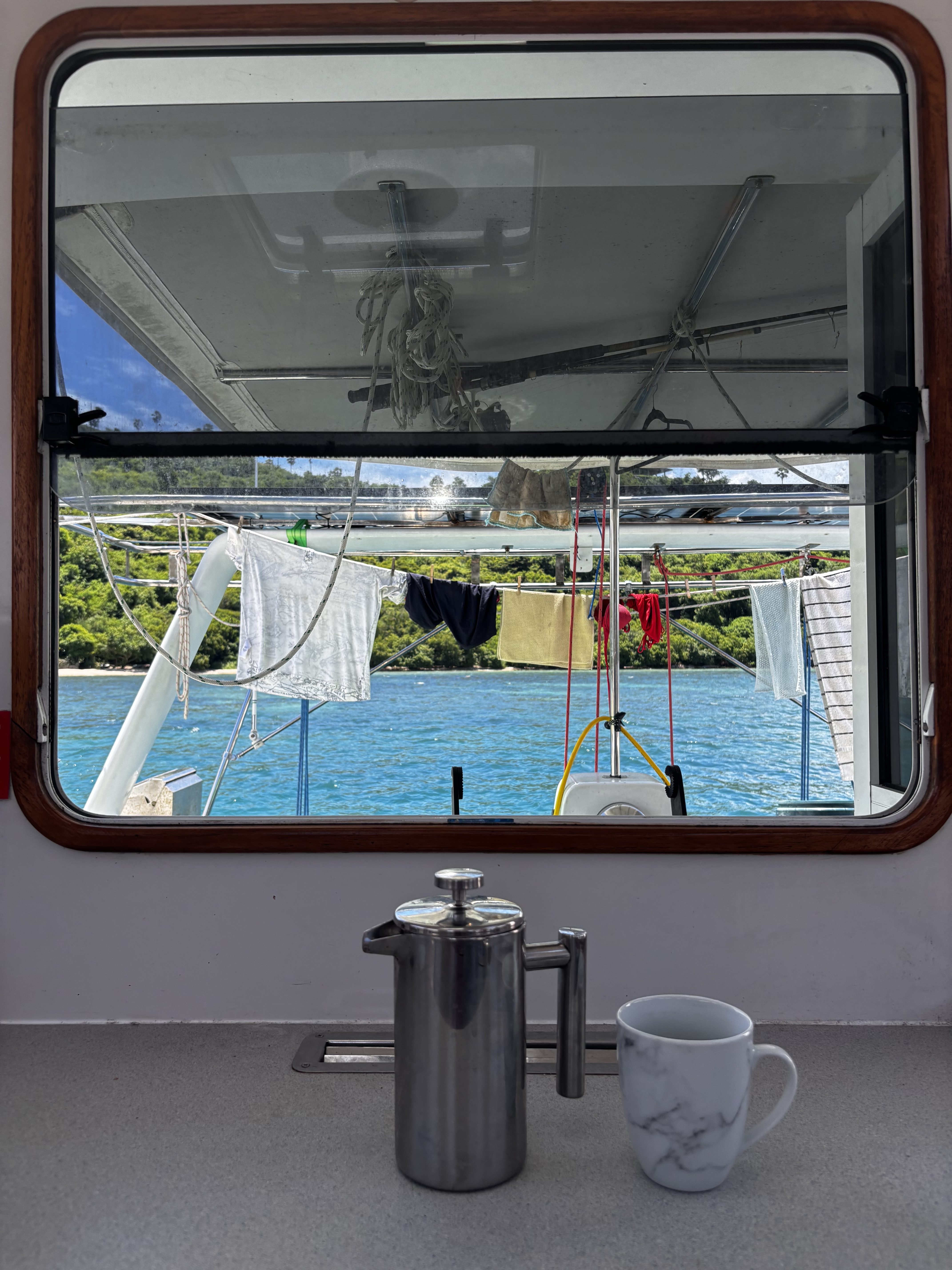
But I brew my coffee. I look out at the Banda Sea and the sky above the horizon – a wash of indigo, that in-between time when the sun has just risen but it’s not fully day yet. I grab my book and head out to the front deck. I do all of this in silence, muted steps from my bare feet over the cockpit. But there’s no one to disturb me.
With every minute, I can feel my nervous system relaxing back to its natural state. I didn’t realise until that moment how tense I had been over the previous six days, the stress of sailing, learning new tasks around the boat, dealing with Dan’s injury, having to navigate seasickness and storms and Dan’s constant mood swings. I release a deep exhale as I take my first sip of my coffee. Reprieve.
Then I stretch back over the arch of the saloon windows and spend the next three hours reading naked in the sun.
The following days blur together in a haze of love and lethargy. In the mornings, we fry eggs in butter and sprinkle our avocados with salt. We eat dragon fruit bought at the local market that stains our fingers a deep purple. When the boat gets too hot, we jump in the ocean, letting the clear ultramarine water cool our limbs. We play cards and scribble in journals and listen to Otis Redding and The Ronettes while the pasta boils.
In the evenings, we lie out on the stern and look at the stars while sharing a beer. We watch Blue Lagoon and pretend we’re marooned teenagers. I read a lot and write even more, while Leon tries to fish. The operative word here being “tried.”
When claustrophobia starts to creep in, we take the tender to the harbour and explore the island. Dr Al (remember the chuckling good doctor?) insists that we use his scooter whenever we’re on land, since there’s no scooter rental on the island (because there are no tourists, of course). He also refuses to accept money for this. Wow, what a man.
So we take the scooter all over the island, exploring every road and beach and hill that there is to find. We come across an adorable seafood restaurant right on the shallows, with palapas for shade and the best view of the sunset. It’s run by a local family who grill their snappers on an open fire and serve them whole, eyeballs, intestines and all intact.
Further along, on the eastern side of the island, we find a fairly hidden beach, tucked up against some sloping cliffs, where we hunt for coconuts and doze in the shade of the palm trees.
Now you’re probably wondering, well, what happened to Dan? We got word from him fairly quickly that he made it to the hospital, had a small surgery (no need for anyone’s leg to be taken off), and was recovering nicely. But we should not be expecting him back anytime soon. Would he take a few days to return? A few weeks? We didn’t know, and to be quite honest, we were having a lovely time waiting. So it didn’t really matter either way.
In the meantime, we also discovered a few breathtaking snorkelling spots around the islets near the boat, where the reef dropped away into the deep blue, and fish moved in bright, shifting clouds. Schools of cobalt parrotfish, glowing sea anemones, alien-like pufferfish with their pouting mouths and disapproving eyes, little Dories and Nemos and angelfish so yellow they looked like they had been dipped in paint. All living and bustling around giant clams and staghorn coral, and the delicate, lace-like structures of sea fans.
We spent much time verbalising our disbelief at this surreal turn of events.
Now, in the interest of not making my life sound more glamorous than it is, there are a few things I must admit here. After a few days on the boat by ourselves, we ran out of fresh water completely. That means our showers, which were already few and far between, had been reduced from one every three or four days to zero. So we subsisted by lathering ourselves with soap and jumping in the ocean.
Shortly after we ran out of water, the toilet also stopped working, which meant we were forced to do our business… well… off the back of the boat. This entailed first making sure no locals were canoeing about in their little fishing boats, followed by a few deep breaths and some vaguely yogic acrobatics. It’s not pretty. And more than once did I notice the appearance of a school of fish after the deed was done.
I’ve recently been toying with the idea of writing a “cool things I’ve done” list, just for myself. You know, to remind myself in moments like these of the crazy things I’ve done and lived through. Also, to prove that discomfort should always be endured for the higher good of a fun little blog post (Exhibit A).
The list is already off to a promising start, with a few solid entries from this journey alone: (1) hitchhiking with a goat bus to go meet a stranger with a sailboat, (2) living on a stranger’s sailboat, and (3) pooping off the back of said sailboat.
I suppose it depends on your definition of “cool.”
It has now been a week since Dan left the boat. He’s in good shape, but upon the advice of his girlfriend and the doctors, he has decided not to return. So he gifted us this beautiful, big, faulty ocean machine, and it is now our responsibility to learn how to sail, or to integrate fully into the community of Tomia and live here for good.
That last part is, of course, nonsense, ha, but I almost got you. He did decide not to return, but sadly, no one is being given a boat. Dan found a stand-in captain who will be arriving in a week to fix the various issues and then set sail, with us as his crew, to Raja Ampat, as was the plan. With this new itinerary, we should be arriving in West Papua in two weeks.
But honestly, who knows?
If there’s one thing this journey has taught me, it is that nothing ever unfolds exactly the way you think it will, and that might just be the point. The best things, the craziest stories, the most vivid memories seem to happen somewhere between the plan and everything falling apart.
So, here we are. You’re all caught up. I’m sitting on the back deck, writing this in real time as the sun sets over the western horizon of Wakatobi and the Maghrib prayers drift out across the water.
I’m looking forward to seeing how the story unfolds. But until then, whatever happens, I’m here. In this body, on this earth. And I’m happy.
Deliciously sun-warmed and salt-skinned, happy.




Leave a Reply