
If you read Part I, you’ll know how we ended up here… forty-eight hours of straight hitchhiking across Indonesia, a goat bus, a spontaneous invitation, and a stranger waiting in the dark. So let’s pick up where we left off.
The boat where I now, for all intents and purposes, live is called Thetis. Named after a sea nymph from Greek mythology, the mother of Achilles. Or rather, the boat is named after the small island off the coast of Vancouver that is named after the mother of Achilles, the island where Dan learned to sail as a boy of ten.
Thetis, as it turned out, is not the glorious white boat that she seemed to be in the tired pre-dawn light of our arrival. Her hull is marred with algae, coated in a film of green, slippery sea residue that creeps up its sides.
Similarly, the insides of the boat are a mess of things – tools, pillows, ropes, broken camping chairs, standby fridges and freezers, petrol canisters, and an array of unfashionable sunglasses. Man’s things. And indeed, later Dan would proudly call it “a man’s boat.” That must be, because, as we soon realised, the boat also doesn’t have a working shower. But it was all part of the adventure, and the boat’s eccentricities only added to our shared giddiness.
I imagined the next two weeks unfurling in a slow sequence of morning journal sessions, cooking pasta while gazing out at the distant horizon, sleeping with the sound of the ocean lapping at the boat, watching sunsets, listening to the boys yell things like “all’s good on the starboard side… raise the sails… ahoy…?” I mean, what did I know? I definitely didn’t account for the many storms we would encounter, the countless hours I would spend lying out on the bow, utterly seasick and holding on for dear life as the boat flung this way and that, the ocean almost as temperamental as Dan’s mood swings.
So another thing, Dan is a type 1 diabetic. He has to inject himself with insulin before consuming anything, food or drink. Sounds easy enough, but sadly (or perhaps luckily in this case) I have my fair share of experience with a type 1 diabetic, so I know what happens when their blood sugar gets too high or too low.
I’ll save you the medical explanations and just say that they get confused. Very confused. Smoke a joint and drink a bottle of wine and listen to Bob Marley confused. And this happens quite easily.
It’s preventable when you’re with someone who knows what to look out for, but if you’re by yourself, it’s actually quite dangerous. For the life of me, I couldn’t understand how this man has been sailing solo around the world for a year and a half in his condition. He must be meticulous about his blood sugar, I remember thinking. Well…
This wasn’t the first instance of foreshadowing though. For one, the water maker on the boat wasn’t working. He has been subsisting on collecting rainwater when it came and pouring a tiny bit of bleach inside to make it drinkable. Next, one of the engines was out, and the autopilot navigation system had to be reset every thirty minutes after sounding an alarm of entirely unknown origin. But he insisted that this wasn’t a problem for our two-week sail.
Furthermore, he had apparently been stuck in the port town of Labuan Bajo for six weeks before our arrival, trying to fix various things, none of which seemed to actually have been fixed, but when we arrived there was suddenly some urgent need to set sail, problems be damned.
All of this made me a tad bit nervous, but again, what the hell did I know about sailing?
We spent the first day doing provisioning for the boat. We walked from supermarket to supermarket collecting bags of spaghetti, frozen vegetables, oats, canned tuna, bananas… all ingredients that Leon and I painstakingly noted down for our planned meals, since, as the deal went, the two of us would pay ⅔ of the fuel we used, ⅔ of all the food, and we would do all of the cooking and cleaning. Dan, for his part, would handle all of the things around the boat, since, as he knew, we have no sailing experience. This seemed like a fair trade.
And it would’ve been, were it to have happened like that. But again, I’m getting ahead of myself.
After our first day of provisioning, we went to get drunk on happy hour margaritas in the town’s only bar. A kind of merry send-off and cheers to the beginning.
I was busy licking salt off the rim of Leon’s glass after having finished my own (salt, that is, not margarita), when Dan said, “Look, the boat’s not perfect. It needs a lot of work.”
He slams back his fourth margarita and, through watery eyes and a lopsided, self-mocking smile, says: “Sailing is the fine art of getting wet and becoming ill while slowly going nowhere at great expense.”
He chuckles to himself and we cheers to this rather drunken recitation of the quote that I’ve seen hanging at the back of his boat.
The cheers teetered on the edge between ironic and prophetic. In that moment, we couldn’t yet know which way fate would fall.
We didn’t end up leaving the next day as it were. The delay was caused by a mixture of our margarita hangovers and another mysterious problem with the boat that Dan couldn’t quite explain but was working away on furiously all day.
At first, Leon and I hustled and bustled around each other, cooking impractically elaborate meals for a tiny sailboat kitchen. Dan later roped us into helping with things around the boat, then making passive-aggressive comments about why the food wasn’t ready yet.
This was the first introduction we had to someone we would come to know intimately over the next few days: hangry Dan.
But we must remember he has diabetes, I chided myself. He must eat frequently or else he starts to feel bad. I know this.
But what we didn’t know was that Leon would spend most of that day in a dive suit with a scalpel, scrubbing away at the hull of the boat, while I was instructed to perform increasingly inane tasks around the boat, like cutting pillowy Styrofoam circles for use as stoppers on the petrol tanks.
“No, this is too thick, I said 4 mm.”
“No this isn’t 4 mm, it’s way too thin.”
“Nope, it must be a circle.”
Etc., etc. You get the gist.
By the end of that day, it was abundantly clear to us that he would be treating us like a paid, experienced crew (that is, abrupt and irritable at any hesitation or uncertainty) and not like the paying guests who are doing the cooking and cleaning hat we thought we were invited to be.
But here I would like to interject: we were elated at the prospect of sailing still. The invitation was a blessing and a great adventure.
Sure, Dan was a little grumpy and bossy, but it’s nothing that we couldn’t handle.
I’m going into detail about the goings-on of the boat and his moods and the failing systems not to complain, but rather, I’m sitting here chuckling while I type away. I find it all to be a rather funny, ridiculous, beautiful story, and I’m grateful to be able to live a life where I can make the spontaneous decision to go on a two-week sailing journey on a moment’s notice.
Okay, disclaimer done… where was I?
As our second day on the boat slipped into dusk, we opened a beer on the hull and watched the sun sink, burnt orange and bruised, behind the surrounding islets and rocky outcrops.
This is the moment I learned that no matter what happens, when one sits on the front of a sailboat, feeling the cool, salty breeze on your face and watching a beautiful sunset, everything in the world feels right and you have no doubt that you’re the luckiest person in the world.
“My ex-wife once asked me whether I would like my daughter to marry a man like me, and I was shocked when I realised the answer was no,” Dan says, matter-of-factly, his gaze fixed on the horizon.
“I was always annoyed and raising my voice. I’ve been spending the last decade working on that. I’m still working on that.”
His mouth is set in a thin, stern line, his grey beard catching the last of the fading light.
It’s interesting that he brought this up now. We’ve been letting some more get-to-know-each-other conversation amble into murkier depths as we sat there sharing a beer, testing out subjects like dreams, fears, loves lost and gained, family.
I venture to guess that maybe he brought this up now as an attempt to apologise. Maybe he realised he’s been short-tempered with us, and wanted to offer some admission of regret.
In an attempt to pay heed to the full nuance of every person, I must say that Dan is by no means a bad guy. I experienced moments with him where he was funny, tender, kind, almost grandfatherly.
Maybe there’s just something about sailing that makes the niceties of early acquaintance fade away. Also, to be fair, he probably thinks I’m flighty and incapable of doing anything physical to save my life. And I wouldn’t begrudge him that opinion.
Each to their own. And anyway, it’s just twelve days… right?
Later in the evening, as we hear Dan’s cabin door click shut, Leon and I decide to go for a late-night swim.
We slip quietly into the water and paddle a bit away from Thetis, so as not to disturb our slumbering captain. We gossip in hushed tones about everything we’ve been experiencing, lie on our backs and watch the stars, let the water cool our skin.
At one point, as we drift a little further still, it feels as though the stars have slipped from the sky to swim with us in miniature. All around our hands and legs, bioluminescent plankton make every movement neon blue. It’s not the first time I’ve experienced them, but every time I do, it makes me feel like a child seeing magic for the first time. Few things can make you forget about all the nonsense going on in your life and the world quite like swimming with bioluminescent plankton. That experience just puts me back in my body, back on this earth, and reminds me that all the other stuff exists in a realm that doesn’t really exist at all.
What exists in that moment is only the slight tingling from where the plankton grazes my sunburnt body, the playfulness in Leon’s eyes when he looks at me, the shining blue bubbles around my legs that make it look like I’m running through a starlit sky, the way he tangles his fingers in my hair when he kisses me under the moonlight.
That’s all that exists, and perhaps, that’s all that ever existed.
I blink slowly, my surroundings coming into focus around me. A strip of sunlight overheating my body, crumpled sheets, the sound of distant things clattering, the smell of the ocean.
I sit up and it feels like I’ve been run over by a bus. A goat bus perhaps. That’s something I would get used to over the coming weeks. I don’t know whether it’s because we sleep so deeply on the boat or whether it has something to do with waking up in such insane heat, but every morning when I open my eyes, it’s an especially arduous task.
But the sound of seagulls, the smell of coffee, the promise of a morning dip.
Dan is already up and about when I open my cabin door. Of course he is. The man sleeps the weirdest hours, three hours at a time here and there.
He seems frazzled about something.
“The engine is still not working.”
Now mind you, he has a way of making every minor emergency sound like the end of the world, but this particular incident does, in fact, warrant his worried tone and wide, circular eyes.
“We have to get out of here now. Right now.”
“Wait, what?” I rub my eyes, sipping my coal-black coffee. I thought he just said that the engine wasn’t working?
“Yep. Right now. Let’s go.”
Maybe he’s a fugitive? I’m so confused.
About thirty minutes later, with only one working engine and without much ceremony, we set sail.
It is the perfect day for sailing. (Actually, I would later be corrected on that. Apparently we needed more wind, but in my mind it was perfect.) The sky glows a soft blue, the ocean a still canvas stretching in every direction. The morning air cool and crisp and salty.
We’re on the move! We’re sailing! And soon we would be on the open water, not seeing land for the next twelve days.
Or so we thought.
Except for Dan being more high-strung than usual, the first day went by relatively uneventfully.
I was learning that out in the open water, the boat moves and rocks and jitters far more than when it’s anchored (one would think that obvious, but to me it was quite the revelation). So my anti-nausea tablets were coming in handy. They worked well at first, but they had an annoying and potent side effect.
They made me very, very sleepy.
So sleepy, in fact, that for the first four days on the water I felt a bit like a walking zombie. I could fall asleep at the drop of a hat. I could fall asleep while cooking noodles. I could fall asleep right after drinking three cups of coffee. And the fact that we were doing two-hour interval night shifts did not make the situation any better.
On the first night, around 3 a.m., Leon gently shook me awake for my first shift.
I peeked my head through the cubbyhole to survey the circumstances.
It was pouring rain. The wind whipping through the sails sounded feral. The boat rocked violently, the sound of things clattering down from shelves, unseen parts deep inside the boat’s guts knocking against each other.
Our first storm.
I was thrilled, a little bit scared, but also keenly aware of the fact that I would be responsible for the boat, under these circumstances, for the next two hours.
Sitting in the cockpit gives you a good view of the ocean up front. But on this particular starless, moonless night, there is nothing to be seen but a vast, swallowing dark.
It’s an eerie feeling, the boat rocking violently, rain pelting down seemingly from nowhere, all the while feeling like you’re sailing into oblivion, or the void. Nothingness.
On nights like these, I often found myself marvelling at the bravery of early-age explorers and pirates. Sitting comfortingly to my right is a big tablet with a navigation system, showing us our exact route and direction, speed and wind strength at any given moment.
But how did the sailors of old do it? With a paper map and a licked finger in the wind? How did they mentally stay strong when faced with this void and pelting rain and nausea and not being able to walk straight without the boat throwing you against the nearest wall? For months. In the hopes of finding what? New lands? Treasure? A fresh start?
It’s admirable, to say the least. Not admirable outcomes (you know, colonialism and all) but you’ve got to at least be impressed by the pure audacity.
That’s what I’m thinking as I’m sitting in the cold and wind, pulling Leon’s rain jacket tighter around my body, squinting through the rain.
I also think about how ridiculous my life is, in the best way. That I, a completely inexperienced sailor, the most susceptible person to seasickness that you will ever encounter, am now in charge of this large vessel barreling through the stormy Banda Sea.
I smile ruefully into the wind.
When Dan comes up from his cabin two hours later, I see he is hobbling a bit. His left leg is slightly swollen. I noticed earlier in the day that he had gotten two thin cuts on his shin, but as they were fairly small and innocent-looking, I didn’t think much of it.
However, now, looking at how such an innocuous cut turned into a wound worth worrying about in a single day, I suddenly remember the thing about diabetics and wounds. They’re susceptible to infections, and their wounds are more risky and take longer to heal.
I mention my worry to him, but he waves it off, and I go back to bed, the sea continuing its ancient rumble beneath us.
I wake up and immediately feel that the atmosphere has shifted.
The sun is shining, I don’t feel violently sick, a moderate stillness has descended on the water, and we are moving steadily ahead.
Things are well.
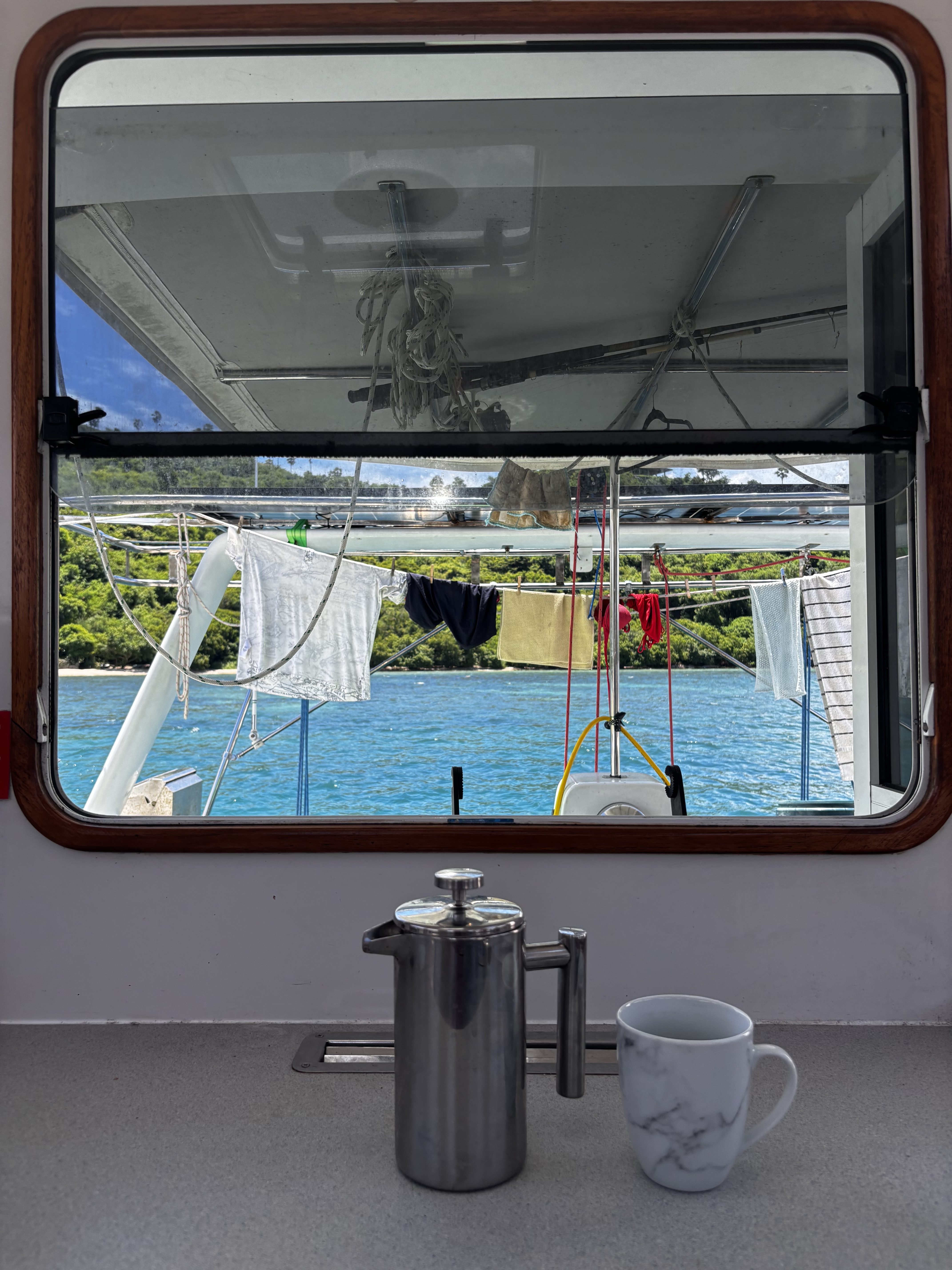
I make oats and fruit. Leon kisses the top of my head as I stare out the kitchen window while the coffee brews. Endless blue all around us.
An idea is forming. I can feel my creative muscles twitching.
As I always do in this state of creative pregnancy, I get the sudden sense that it’s September.
You see, for me, it almost feels like life begins in September. Every time I’ve fallen in love, it was in September. September is the month the bougainvilleas start to bloom on the farm where I grew up. I got my first period on the first of September 2013. September, for me, has always brought with it the distinct sense of possibility, the feeling that anything can happen and that the world is at the tip of my fingers. That my life is stretching out ahead of me, and I can do anything I like.
That’s how I felt that morning, looking out at the Banda Sea.
And it’s always how I feel before I write something great.
I learn quickly, though, that the ocean and our captain do not carry much regard for the tides of my inspiration. We are thus quickly set to work, and I am forced to mourn the passing of my unbirthed work.
If it sounds like I’m being dramatic, it’s because letting a wave of inspiration go by without seeing it through to paper is indeed an unthinkable, dramatic sin in the life of a writer.
Can you hear I’m still not over it?
Over the next two days, Dan’s leg gets increasingly worse. Every few hours it seems more swollen and red.
By the end of day three, little bubbles of pus have formed around his shins, and his foot is so inflamed that he cannot walk anymore. We finally convince him to change course so that he can get to a hospital.
The problem is, at this point, the closest we are to any form of civilisation is the tiny island of Tomia in the region of Wakatobi in Eastern Indonesia.
We veer four hours off course to anchor near their desolate docks.
But the anchoring itself proves to be a challenge. Dan makes us put down and pull up the anchor about five times, because every time, for some reason, the depth or something else is wrong.
I find this very strange since he can see our depth on the tablet, but alas, I don’t question him. I will realise only later that he was already at that point, confused, from the sepsis seeping into his blood and the high blood sugar his body was producing to try and fight the infection.
After we finally manage to lay anchor and things seem more calm, it is already well past 9 p.m. Dan lies down on the stern and falls asleep.
I’m lying in Leon’s lap inside, reading, when, three hours later, we hear Dan start to mumble.
Of course, we think he’s talking to us, but when we go outside to check on him, his eyes are closed. He is shivering, sweat dripping from his forehead, and he is talking to nobody but himself. Senseless, half-formed sentences heaved out in between tremors. I touch his forehead and gasp. His skin is on fire. Something is very, very wrong.
It is in this moment that it dawns on me, we are in one of the most isolated, remote regions of Indonesia on a sailboat with no sailing experience and a captain in such bad shape that I honestly fear for his life.
I am scared. I am seasick. My imagination is also running away with me, writing the headlines, inventing the police officers’ suspicions if something does, in fact, happen to him while mysteriously out at sea with a couple he only met a few days ago.
My eyes flick to the few speckled lights of Tomia in the distance. I wonder what we’ll find there, how we’ll get there, what new turn of events the morning will bring.
I take a deep breath and call the police.
(Part III coming soon)



Leave a Reply