
I am living on a sailboat. Quite by accident and under rather preposterous circumstances, I might add.
About two weeks ago, we got an invitation from a Canadian sailor to join him on a 10-day journey from the island of Flores to Raja Ampat, a region of Indonesia that edges a little too closely to its more infamous neighbour, Papua New Guinea. A place often associated with some of the last cannibalistic tribes in the world. They paint their bodies a ghostly white, mouths a vivid, unsettling red, and make fires atop elaborate constructions perched on their heads. That is, of course, in the more remote, jungled areas. I could venture a guess that no cannibalistic activities occur in cities like Port Moresby. Although, Port Moresby has its own skeletons.
But, I digress. We aren’t even sailing to Papua New Guinea (or anywhere, it seems at this point). We are supposedly, hopefully, sailing to Raja Ampat, the much tamer end of Papua, although it does share the same island, if not the same diet, one hopes.
Raja has its reputation in travel circles too, known for its iconic dive sites that boast a diversity and abundance of marine life “similar to that of a hundred years ago,” or so Netflix claims in their recent documentary of the place. So, of course, you can imagine our elation when the invitation came through, from a stranger on the internet no less.
We got on a ten-minute video call with… for anonymity’s sake let’s call him Dan. Dan seemed jovial, reminding me a little of my grandpa actually. He hinted at his boat having a few problems, but nothing that would deter the journey. So a decision was made, and Leon and I changed our plans on a whim.
Instead of spending the next week on Lombok and then making our way slowly over the islands of Sumbawa and Komodo, we instead made what would have been a two week journey, in 48 hours. It would’ve been 24 hours, but Google Maps obviously doesn’t calculate the unreliability of the Indonesian ferry system, the speed of goat delivery buses, and the frequency with which the drivers of said bus would want to stop and make a smoke break.
Wait, I feel like I need to pause here. This interlude deserves being mulled over for a bit, for it could well be its own story.
Now imagine this… We’re in the middle of Sumbawa, an island not used to tourists, despite its proximity to Lombok. It is rural, but unlike the charm of Sumatra, Sumbawa’s agrarian feel is less calm pastoral and more stripped down and poor. The landscapes are still breathtaking, though. Rolling hills covered with farmlands, cows grazing beneath palm trees, the glittering blue Flores Sea always in the distance. But the whole island has a distinctly “in the middle of nowhere” feel about it.
So anyway, it’s dusk and we got dropped off at a local bus station by a very nice gentleman with a pickup truck who hauled us and our two big backpacks all the way from the harbour to where we now find ourselves.
We have to hitchhike our way through Sumbawa because all the buses are either full (it’s the end of Ramadan) or non-existent. Alas, at this bus station we find out again that no buses are available for us bule (read: white people), so even though it is almost dark and even though we are starving and tired, we decide to hitchhike further with the hopes of at least reaching the “capital” of Bima, a destination four hours away, before calling it a day.
We try for at least forty minutes, but no luck. People are kind and curious, so they stop, but no cars are going outside of Talliwang, much less anywhere near as far as Bima.
After a while, a local man who has been watching our efforts amusedly from his stoop comes over and tries to stop cars with us, explaining to the confused locals that we would like a ride. This too doesn’t work.
As we’re about to give up, a large bus – a school bus – rattles loud and slow around the corner. The young man driving the rickety thing grins from ear to ear as he spots us and slams to a stop.
“Bima?” we ask hopefully.
And I swear we might as well have said Santa Claus came, because sure enough he jerks his head up and down excitedly.
“Bima,” he confirms.
I smell them before I see them. But I hear them before I smell them.
We clamber inside and my suspicions are confirmed.
The bus is filled with goats.
Goats stacked on top of the seats, goats in the aisle, goats sticking their heads out of the windows, a great big bleating cacophony of goats. All of them utterly adorable and unbelievably smelly.
Leon and I just laugh as we climb in and put our backpacks on the only two empty seats that are not occupied by the dusty little nomads of the hills.
We wave goodbye to the local man who helped us pull over cars, and off we go to Bima in our goat bus.
What would have been a four-hour ride turned into eight of the most ridiculous, anecdotally laden hours of my life, because, as it turns out, this bus was a goat delivery bus, which meant that they had to make frequent stops to present the local families of Sumbawa with their livestock.
All the way from Taliwang to Bima, the bus rattled as fast as it could, the two young drivers chain-smoking furiously and blasting Indonesian trance music so loud I was scared the old speakers were going to burst.
Outside, the night air was filled with the thick promise of oncoming rain, and as sure as I thought it, the clouds opened. A rainstorm hit us full-frontal, and on the ancient iron roof of the bus it sounded violent.
I could barely see anything past the smudgy windows, and I tried not to wonder how our young companions saw the road ahead, if at all. But they seemed unperturbed.
They continued chatting merrily, or rather, grinningly screaming at each other over the blasting music, bleating goats, and loud rain.
At some point, just as I miraculously was able to nod off, they turned on the bus’s internal overhead lights, a flashing neon green situation that added the final touch of hilarity to an already ridiculous situation.
Our goat delivery vehicle turned party bus, stopped every fifteen minutes or so. Then one or the other of the drivers would climb, spiderlike, over the bus’s seats, feet finding the tops of the backrests to retrieve the specific goat that had reached its new home.
Other times they merely stopped because they’d seen an especially delicious leafy branch on the side of the road that would make good dinner for the goats. So then they bring the branch in, and the goats munch happily and we continue on into the dark, stormy night.
As if by pure miracle, at 2 a.m. we reach Bima.
The bus drivers (shepherds? goat couriers?) kindly drop us off at the next bus station, where this time we luckily do find a bus to the port town where we were to get on our final ferry to Flores.
We are told the bus only departs in four hours, though, so we find a homestay next to the station to rest our eyes for a bit before we continue our harrowing journey.
I must talk a bit more about this “homestay,” though.
The bus driver from whom we buy the tickets for the following morning takes us through a small alleyway next to the station to where a middle-aged man sits sleeping on a plastic stool outside of a building with a closed roll-up door.
He shakes him awake and says something in Indonesian along the lines of “bule want bed.”
The other man, a stout, bearded figure, understandably irritable from the rude awakening, opens the roll-up door and leads us unceremoniously to a tiny back room with two twin beds, a squat toilet, and no shower.
The yellowing mattresses have matching holes in them. Some look like cigarette burns, others more mysterious.
“175,000,” he says matter-of-factly, rubbing his beard.
His whole demeanour says, let’s get this over with so that I can go back to my plastic chair.
Now you must understand that 175,000 rupiahs is already a fair bit of money for a night’s stay in Indonesia. It amounts to about $9. Not outrageous for a nice place, but for this place? In Bima? For four hours of sleep and no shower? It’s ridiculous. We paid less than that for the most beautiful wood cabin nestled in the mountains along the rice fields in Bali, just for context.
Leon tries to bargain, but this man knows we are tired and there are no other options. So he stands firm, and we fork out what feels like a fortune for the tiny room.
We slump into bed and quickly fall into a dreamless, goat-less sleep.
I’m going to fast-forward through the next bit, because even though we still had our fair share of hiccups and funny stories and late ferries, it doesn’t quite measure up to the goat bus.
Plus, I want to get to the sailing part.
So anyway, after another 24 hours of travelling we make it to the port town of Labuan Bajo, exhausted, starving, still.
Dan, our soon-to-be captain, tells us to walk ten minutes from the big harbour to a smaller one where he will come to collect us with his tender (a small motorboat used to shuttle to and from the anchored sailboat.)
It is dark. Labuan Bajo sleeps. Only a few early morning sellers are awake and quietly prepping their food stalls. The water laps softly around us. It’s a calm night. No wind. Stars speckle the black sky, a crescent moon faintly illuminating the world around us.
We arrive at the tiny harbour but there is no sign of Dan.
We wait. Ten minutes turn into fifteen, turn into twenty. No messages from him either. In the eerie calm of the night, an uncertainty grows. Both Leon and I know what the other is thinking, but we dare not say it aloud. It is in this stillness that the full absurdity of our decision finally dawns upon us.
We have travelled forty-eight hours straight from Lombok to a town that we knew nothing about, to supposedly be collected by a stranger we’d only met once on a FaceTime call, and then get on a boat with him (alone) for a two-week sail across the open ocean. Neither of us have any sailing experience, might I add. And I also have a tendency to get wildly seasick. Even just swimming in the ocean too long makes me seasick. So maybe this wasn’t the most thought-through decision we’ve ever made.
Maybe he isn’t even coming. Maybe he changed his mind. Maybe he was just messing with us and was never planning to take us along. Maybe he’s a murderous madman. Maybe… “Wait… what’s that light?” Leon says, standing up.
“I think that’s him.”
A joint sigh of relief. We both start laughing as the ridiculous scenarios we’ve been imagining start to dissolve.
And so it came to be that at exactly 4:25 a.m. on the morning of 15 March 2026 we meet our soon-to-be captain, Dan Wilson.
He emerges from the dark ocean as a mythical figure, holding his torchlight aloft like one would imagine a graveyard keeper holding up a lantern.
“Well, look who it is,” he says warmly, as if we’re old friends making a reacquaintance.
It feels reassuring, this assumption of familiarity. His voice is affable and distinctly Canadian.
We manoeuvre our two big backpacks and ourselves onto the remaining space on the tender, almost sinking in the process, but eventually we fit snugly and speed over the water.
And even though the wind is in our ears and the engine is buzzing and it is completely impractical, we try to make get-to-know-each-other small talk. In the short 10-minute ride from the harbour to the sailboat, through lots of “HUHs” and “WHATs,” we find out that Dan is a 63-year-old retired contractor from Vancouver. He sold everything he owned about a year and a half ago to buy a boat and sail across the world. He has one daughter, an ex-wife, and a girlfriend over in Australia who joins him on the boat every two months or so.
If you were to tell me, in that moment, everything that was to happen over the following two weeks, I would not have believed you. He seemed healthy, capable, nice. But, I’m getting ahead of myself.
As we pull up to the boat, the first light is just starting to soften the sky into blue. The anchor light at the top of the mast blinks like a welcoming.
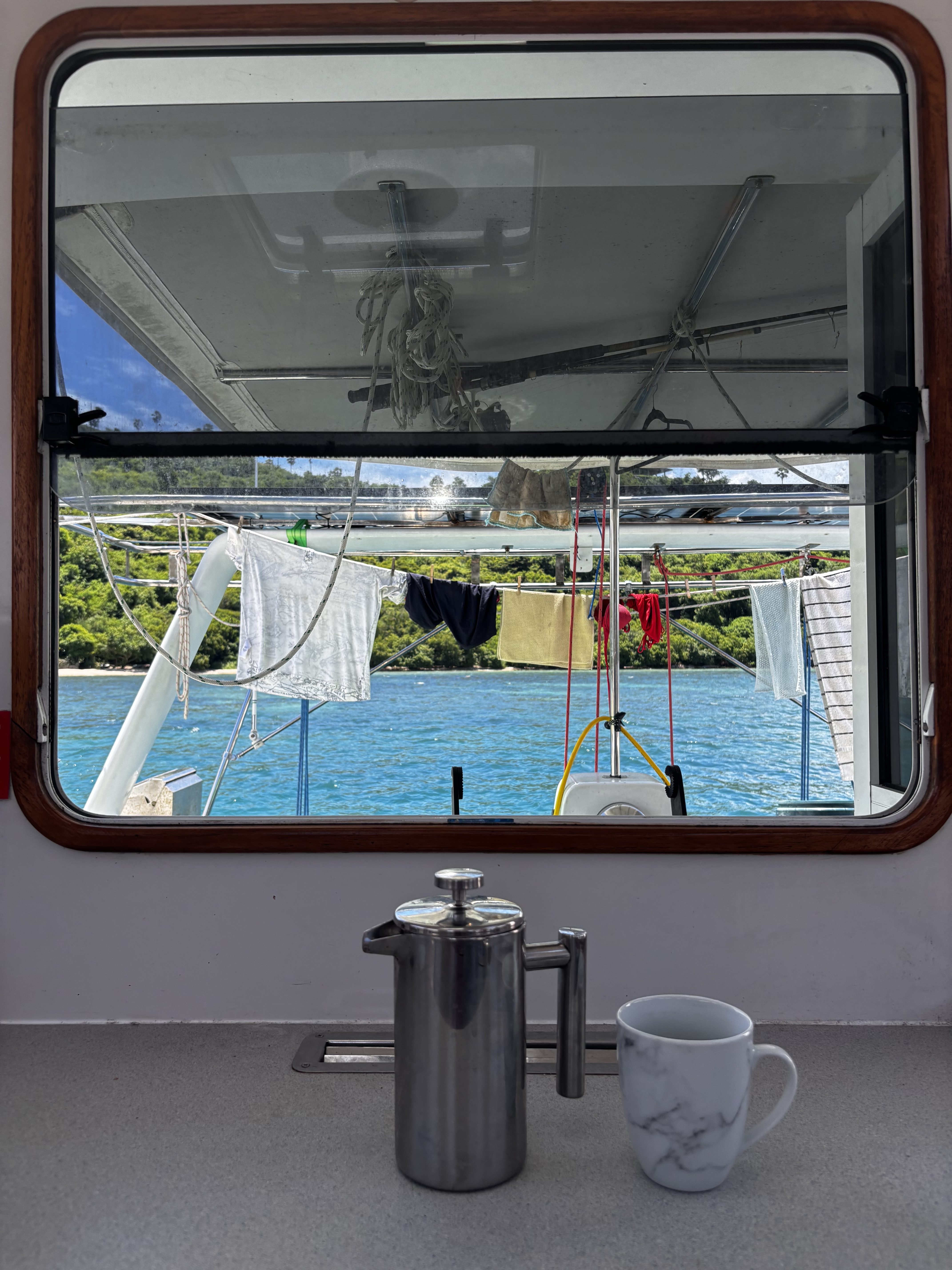
Now, thinking back to my first impressions of the boat, it’s smudgy with fatigue. I remember thinking it was big and beautiful and startlingly white. A real sailboat, wow. But most of all, I was just excited for the prospect of a real bed.
Not long after arrival, we crawled into our cabin bunk and allowed the tide to rock us to sleep, while outside, the sun was unfurling higher into the sky, daylight warming the stern, the boat readying itself for this most unlikely of journeys.




Leave a Reply